

Santo Domingo, Dominican Republic. From September 7 to 11, the Dominican capital hosted the XLVIII Meeting of the Central American Isthmus Port Authorities (REPICA), the annual forum that brings together authorities, operators, and experts from the maritime and port sectors of Central America, the Caribbean, and other regions of the world.
The event, organized by the Central American Commission on Maritime Transport (COCATRAM), together with the Dominican Port Authority (APORDOM) as the host-country institution, was held at the Crowne Plaza Santo Domingo and welcomed 397 participants from over 14 countries: Belize, Brazil, Chile, Colombia, Costa Rica, Dominican Republic, Ecuador, El Salvador, Guatemala, Honduras, India, Mexico, the Netherlands, Nicaragua, Panama, Peru, Spain, the United States, and Uruguay.
The event was also supported by 46 sponsors and featured the participation of more than 40 companies from the sector, which showcased their products and services in an exhibition area open during the main days of the program.
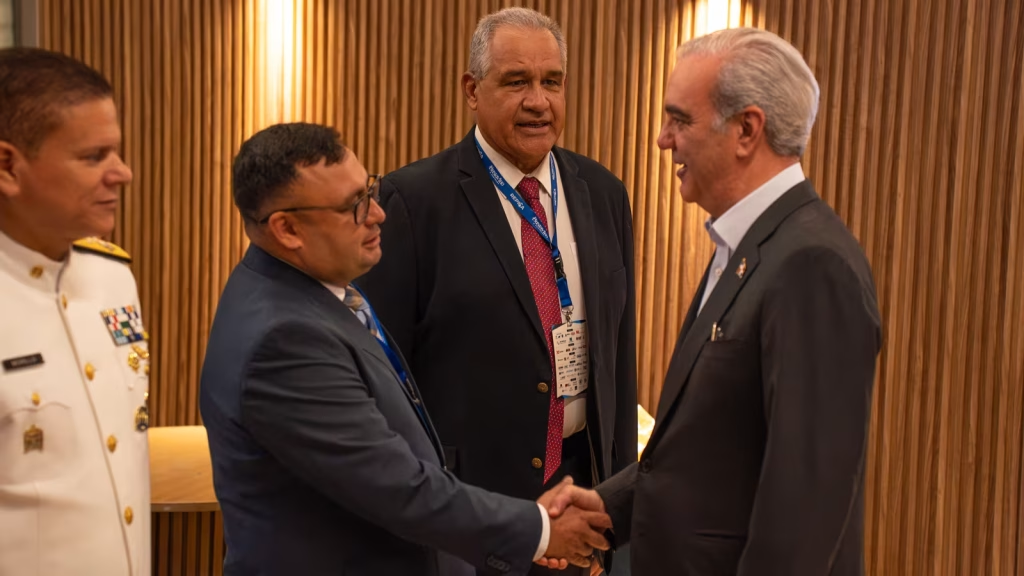
AN EVENT WITH PRESIDENTIAL DISTINCTION
The XLVIII REPICA officially began on September 7 with the Meeting of Members and Permanent Observers, held in the Onyx Room of the host hotel. During the session, delegations addressed administrative matters, welcomed new members, and shared updates on the work carried out since the previous edition of the event.
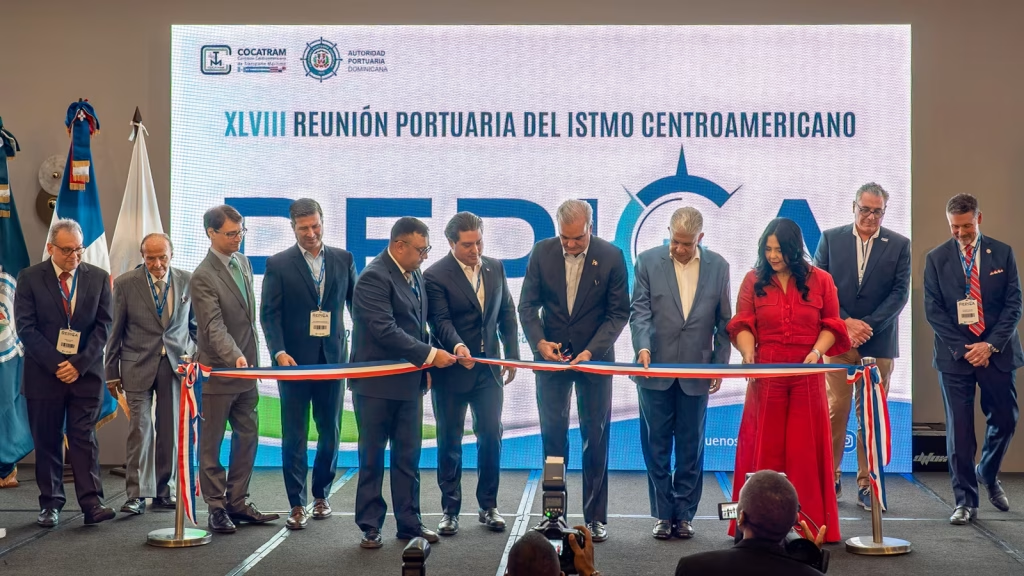
The most solemn moment took place on the afternoon of September 8 with the opening ceremony in the Las Américas Ballroom. The ceremony was attended by the President of the Dominican Republic, Luis Abinader, who performed the official ribbon-cutting, a gesture underscoring the significance of the event and its relevance at both the regional and international levels.
In his remarks, the Dominican President emphasized the strategic role of the logistics and port sector in national development: “The logistics and port sector is vital for every nation. Without adequate ports and a policy aimed at logistics growth and expansion, a country cannot develop. (…) In the Dominican Republic, we understood this from the outset. That is why we have promoted public policies and strategic public-private partnerships to foster economic development and position the Dominican Republic as a logistics hub for Central America and the world.”
José F. Suriano, Pro Tempore President of COCATRAM and Vice Minister of Transport of Guatemala, called for regional unity: “If we are all aligned around collaborative work and a shared vision of development, together we can achieve significant changes for the region.” His remarks referred to the strategic geographic position of Central American ports within the continent’s supply chains.
Francisco Alejandro Campos Álvarez, Executive Director of APORDOM, provided an overview of the Dominican Republic’s progress in the cruise segment: “The Dominican Republic of 2026 is not the same country that faced the pandemic. Today, we have six cruise terminals and expect to close the year with three million cruise passengers. By the end of President Abinader’s second term, the goal is to reach nine terminals and welcome more than five million cruise passengers.”
Otto Noack, Executive Director of COCATRAM and Technical Secretary of REPICA, highlighted the forum’s evolution: “The evolution and consolidation of REPICA over the past few years have been remarkable. This gathering was created as a space for exchanging experiences and generating opportunities. Over the years, it has taken a significant leap forward by strengthening connections that extend well beyond the event itself, fostering partnerships and promoting the development of maritime-port infrastructure and services that have enhanced the competitiveness of the region’s ports.”
TECHNICAL PANELS: WHERE THE IDEAS SHAPING THE FUTURE OF THE REGION’S PORTS TAKE FORM
From September 8 to 10, the Las Américas Ballroom hosted nine panel discussions and six thematic presentations addressing some of the sector’s most pressing challenges, including regional integration and competitiveness, technological innovation, the cruise industry, smart ports, port safety and security, environmental management, and supply chains.
The panels focusing on technology and modernization attracted considerable interest from attendees. During “The Influence and Impact of Artificial Intelligence on Ports,” Miguel Garín of Fundación Valenciaport examined how AI is redefining port operations throughout the region.
The panel on port safety and security brought together perspectives from Captain Francisco Tomas of the Specialized Port Security Corps (CESEP), César Cabrera of DP World Dominican Republic, and Montserrat Ambriz of the Inter-American Committee on Ports of the Organization of American States (CIP-OAS), among other speakers.
The cruise industry, a segment of particular importance to the Dominican Republic, was addressed by Sharon Mei of the Amber Cove Cruise Terminal and Matthew Weintraub of Norwegian Cruise Line. Meanwhile, the smart ports panel featured representatives from HIT Puerto Río Haina, Operadora Portuaria Centroamericana (OPC), and INFOPORT, several of which also served as sponsors of the event.
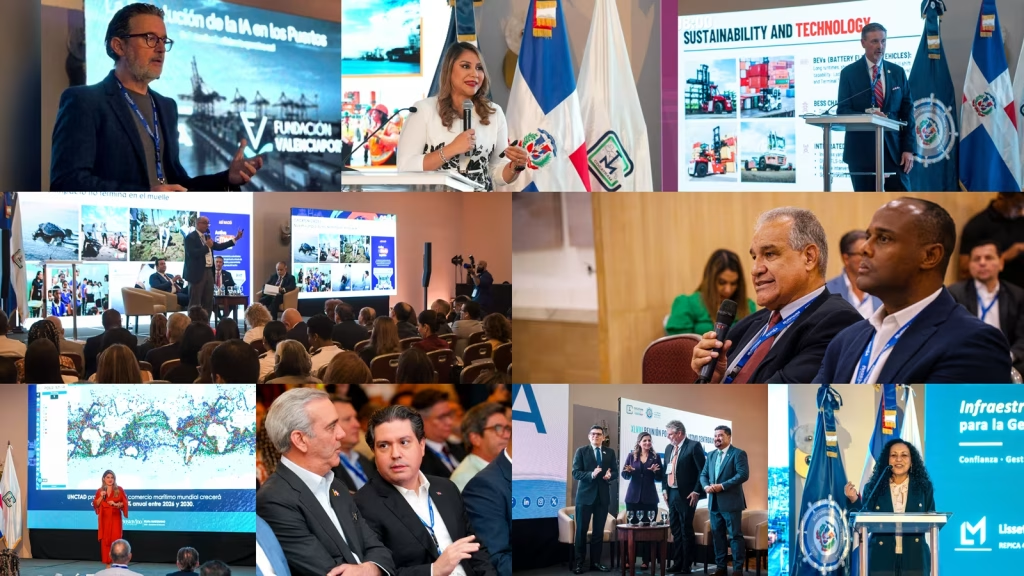
As part of COCATRAM’s institutional participation, Hugo López, Director of Training and Capacity-Building, delivered a presentation on the adoption and implementation of the Maritime Autonomous Surface Ships (MASS) Code and its impact on port operations. Lissette Moreno, Content Editor and Social Media Manager at COCATRAM, presented “Digital Communication: Strategic Infrastructure for Port Management,” in which she argued that communication should be understood “not as a decorative function, but as a management capability that connects operations, trust, and continuity.”
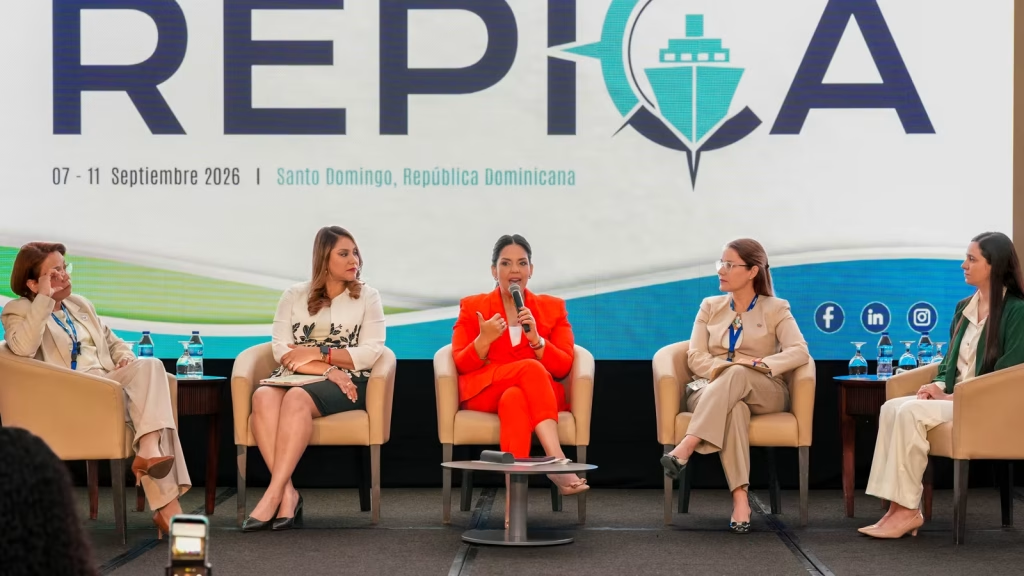
A special moment in the program was the panel “Women Who Move Ports, Building Development,” moderated by Julia Luz Muñiz Suberví, Chair of the Board of Directors of APORDOM. Muñiz Suberví also accompanied President Abinader during the opening ceremony and attended the event’s closing session.
On the final day, a Cooperation Agreement was signed between Guatemala’s National Port Commission, in its capacity as the Designated Authority, and the Specialized Port Security Corps (CESEP) of the Dominican Republic.
At the conclusion of the event, Belize was announced as the host country for the next edition of REPICA, to be held in 2027.
Ultimately, beyond the panel discussions and the figures, the XLVIII REPICA leaves a legacy that extends far beyond its formal program: a renewed network of connections among authorities, operators, and service providers who will continue their dialogue long after the doors of the Las Américas Ballroom have closed.
Every hallway conversation, every potential partnership outlined in the exhibition area, and every project shared among delegations confirms that REPICA is no longer simply an annual gathering, it has become a living platform for regional cooperation.
With their sights set on the challenges ahead, including the energy transition, port digitalization, and the logistics competitiveness of Central America and the Caribbean, organizers and participants leave Santo Domingo confident that the region’s port development will continue to be built, as it has been thus far, through joint effort and collaboration.
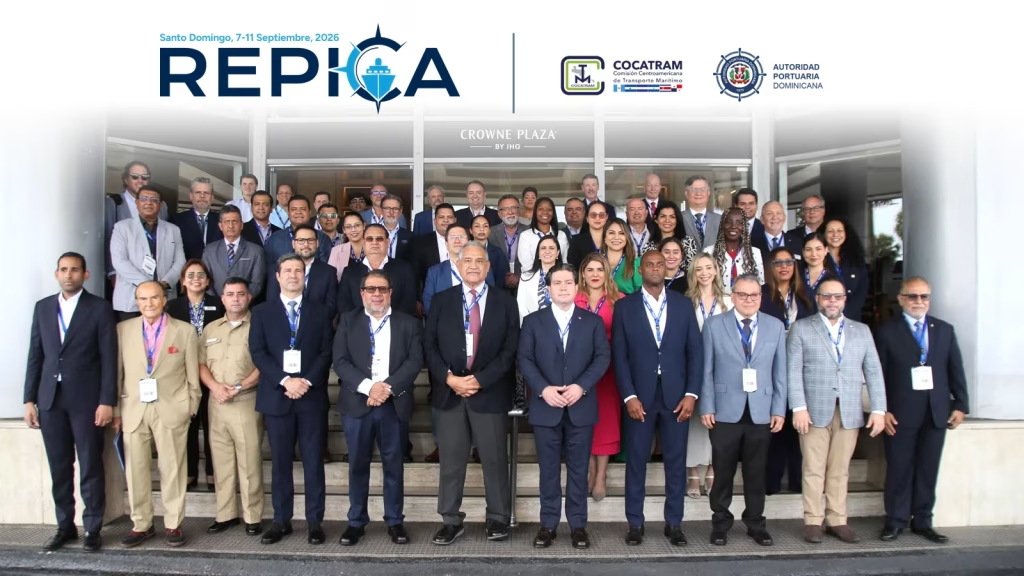
Photos: Courtesy of APORDOM and Nación Logística
