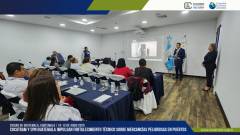
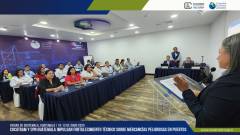
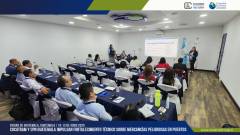
From June 10 to 13, 2025, the Seminar-Workshop entitled “Evaluation on the handling and storage of containers with Dangerous Goods in Ports and Terminals of Guatemala and the International Maritime Dangerous Goods Code (IMDG)” took place in Guatemala City. This event was organized by the Directorate of Maritime and Port Affairs of the Central American Commission on Maritime Transport (COCATRAM) in collaboration with the National Port Commission of Guatemala (CPN), which hosted the event.
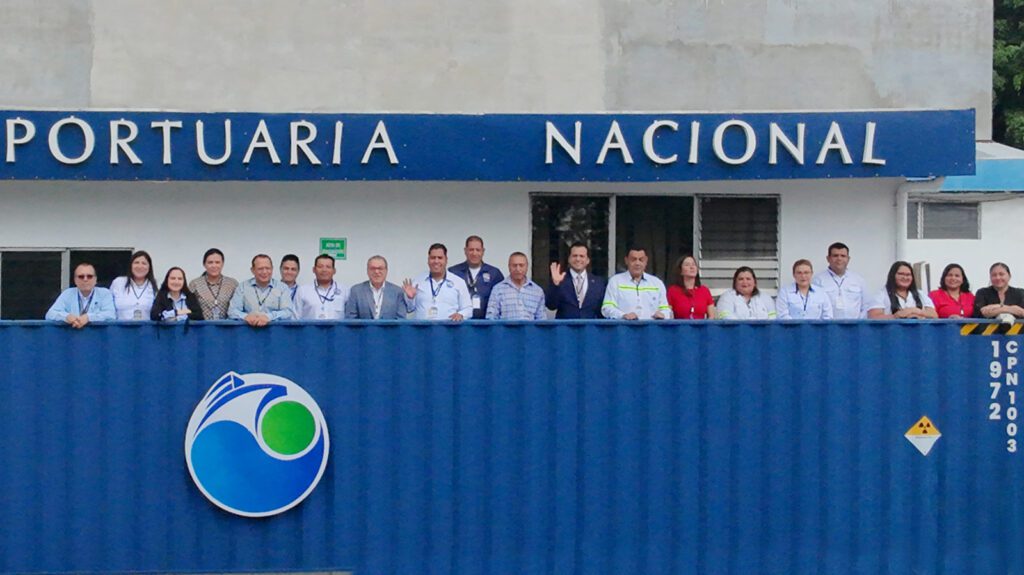
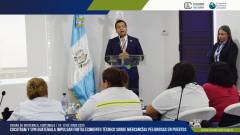
The meeting took place in the National Port Commission’s headquarters meeting room and was attended by representatives from various Guatemalan port terminals, with the aim of strengthening technical capacities in the safe management of dangerous goods, in accordance with international regulations. The activity was inaugurated by Otto Noack, Executive Director of COCATRAM, together with Leonel Molina, General Coordinator of the CPN, who highlighted the workshop’s relevance to the regional agenda for continuously improving maritime-port safety.
During the first day, participants received a detailed introduction to the international legal framework for the transport of dangerous goods, with emphasis on the SOLAS and MARPOL conventions, as well as the structure and application of the IMDG Code. Consultants Klaus Essig and César Murillo guided the technical sessions addressing the classification of these goods, special provisions, types of packaging, and the different requirements for containers and tanks, generating a space for technical and regulatory exchange among attendees.
The second day of the workshop focused on shipment procedures, documentation and labeling according to the IMDG Code. Key aspects of stowage and segregation on board ships were also addressed, as well as emergency action protocols. These protocols included the use of the IMDG orange book and guidelines for responding to incidents involving dangerous goods containers based on case studies.
During the third day, work was carried out to validate the diagnoses previously prepared on the current handling of this type of cargo in the country’s different ports and terminals. Based on this analysis, operational and regulatory gaps were identified, and improvement strategies were defined by working in technical groups by port, with the methodological support of COCATRAM and invited specialists.
Finally, on June 13, the action plans designed by each port and terminal to optimize the management of dangerous goods in their respective facilities were presented. The workshop concluded with a space for joint reflection, presentation of certificates and a closing ceremony, consolidating this workshop as a firm step towards the modernization of port operations in Guatemala and reaffirming COCATRAM’s commitment to continue strengthening technical capacities in the region.